Showing posts with label Idaho. Show all posts

Wednesday, May 19, 2021

To predict cheatgrass die-offs we must understand their cause

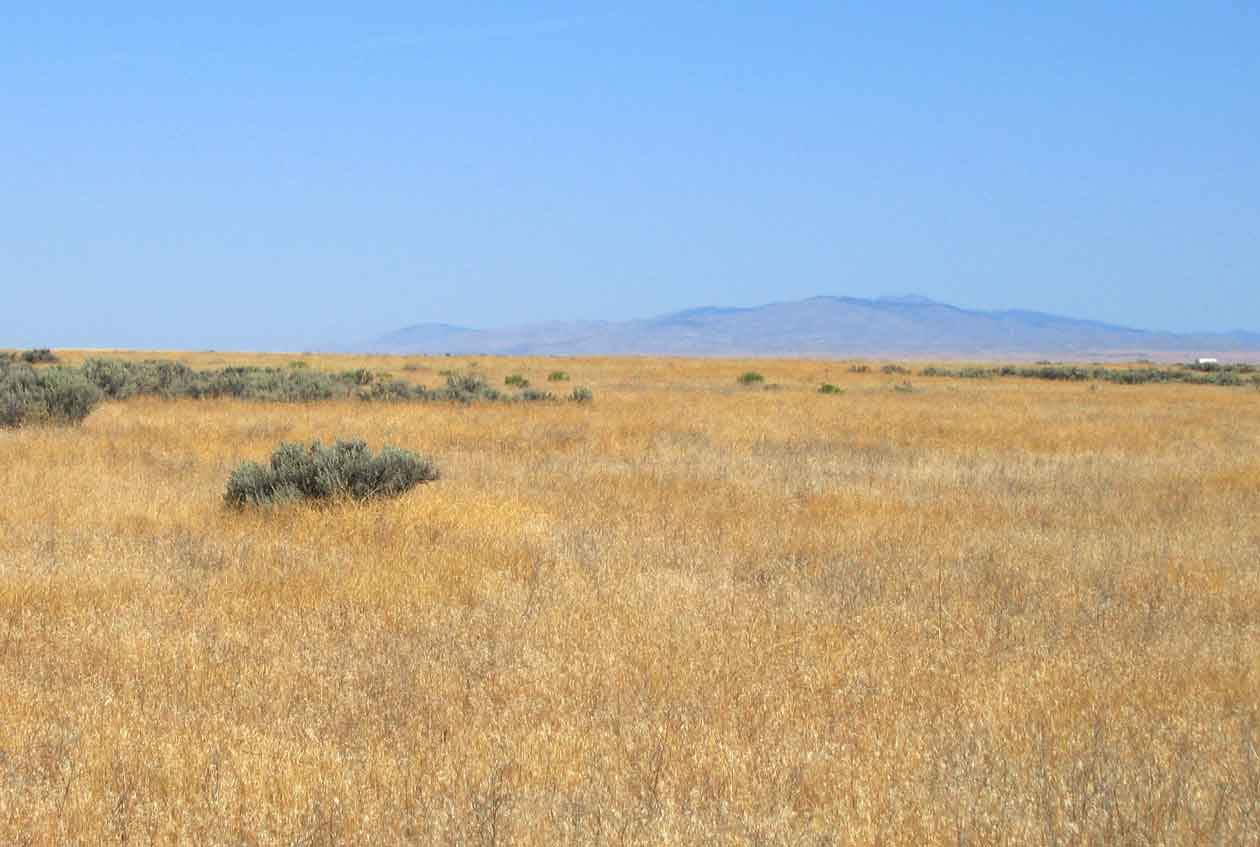
Army cutworms created this large die-off near Bruneau, Idaho in 2014.

In brief 

• Exotic cheatgrass fuels rangeland wildfires in the intermountain west.
• Cheatgrass die-offs are large bare patches that appear suddenly in cheatgrass-invaded areas.
• Die-offs are opportunities to reseed invaded areas with native species while there are few cheatgrass seeds to sprout and compete with sown plants. 
• Army cutworms (ACW) consume cheatgrass seedlings to produce die-offs and can also defoliate native shrubs. The larvae hide in plain sight by feeding at night in winter and spring and hiding during the day. Later, they pupate in the soil and fly away. 
• Major ACW outbreaks and die-offs in 2003 and 2014 occurred during drought broken by late summer rain, which germinated cheatgrass for larvae to eat. 
• Two recent federal reports overlook ACW as the most likely cause of die-offs. 
• Both reports state that fungal pathogens cause cheatgrass die-offs. However, fungi have not been linked to die-offs, are rare during drought, and would require a more complex series of events to damage cheatgrass. 

Download a pdf of this post here.

Cheatgrass (Bromus tectorum) die-offs are bare areas, often covered with gray plant litter, that appear suddenly within stands of normal-looking cheatgrass. Die-offs have distinct boundaries and can cover up to several square miles. Perennial grasses and forbs within die-offs are unaffected, but the exotic annual mustards (Brassicacaea) that often grow with cheatgrass are also missing. Cheatgrass die-offs are sporadic in time and space: widespread die-offs occur relatively rarely, and die-offs only infrequently reappear in the same place.

Die-offs first appeared in low, dry areas of the intermountain west in 2003, during a major army cutworm (ACW) (Euxoa auxiliaris) outbreak. B. Hammon of Colorado State University (personal communication 2003) described conditions leading to the outbreak and die-offs: 
1. a previous year of dry weather created many egg-laying sites, 
2. late summer rain germinated cheatgrass for larvae to eat, 
3. a large flight of ACW (miller) moths in fall laid many eggs, 
4. dry fall and winter weather allowed many larvae to survive and consume cheatgrass seedlings.

Ranchers and at least one researcher watched ACW eat cheatgrass in early 2003. Entomologists saw extensive ACW damage to crops in southwest Colorado and northern New Mexico. I saw a cheatgrass die-off in Nevada on April 17, 2003, but didn’t learn the cause of the bare area until later that year. 

Army cutworm outbreaks in the intermountain west are most likely after a year of dry weather is broken by September rain, followed by a large flight of miller moths, and a second period of dry weather through January.

My 2004 research poster described how ACW outbreaks could create cheatgrass die-offs (Salo and Zielinski 2004). I recognized the appropriate conditions in January 2014 and found ACW in cheatgrass die-offs in late February in Owyhee County, Idaho. Die-offs also occurred in northern Nevada in 2014. In a research paper, I documented larval damage and vegetation recovery (Salo 2018).

A remote sensing study has since confirmed that cheatgrass die-offs are most likely during a dry winter following a previous dry year (Weisberg et al. 2017). The lead author told me their study did not look at the effect of September precipitation.

Army cutworms are the most likely cause of cheatgrass die-offs 


A recent U.S. Geological Survey report (Remington et al. 2021) and an earlier U.S. Department of Agriculture report (Crist et al. 2019) both recognize cheatgrass die-offs as opportunities to reseed cheatgrass-invaded areas with desirable native species, but both overlook ACW as the most likely cause of die-offs.

By spring, army cutworms are big and easy to spot.
Army cutworms are the simplest, most direct cause of these events. Ranchers, who are out on rangelands in winter and at night far more than researchers and federal land managers, are familiar with ACW eating both cheatgrass and crops. Entomologists watch for ACW damage to wheat and canola, closely related to cheatgrass and weedy mustards.

The life histories of ACW and cheatgrass interact to create sporadic and spotty die-offs. To reach outbreak levels, ACW need cheatgrass seedlings for food in winter and early spring. Cheatgrass seeds need significant rain during usually-dry September to germinate in time to feed ACW. The rarity of significant rain at this time means that ACW outbreaks are relatively rare. The larvae earn their common name for their habit of marching en masse to find and consume essentially all their preferred plants--creating bare areas. 

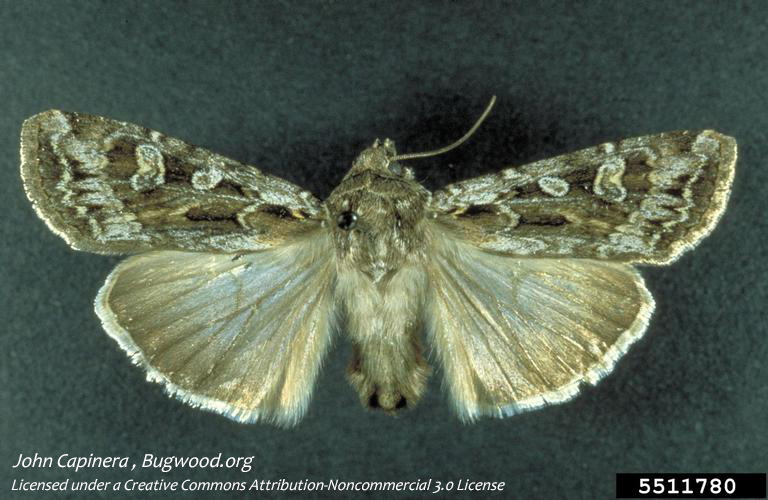
Adult miller moths emerge in late spring.
After ACW pupate, the adult miller moths fly to high elevations, leaving no fingerprints behind. The moths spend the summer feeding on nectar and being fed upon by bears

The following fall, the moths catch wind currents back to low elevations. The capriciousness of wind makes it unlikely that eggs will be laid in the same place more than once. A remote sensing study found that over 80% of die-off sites do not experience die-offs the following year (Weisberg et al. 2017). 

However, both recent federal reports overlook the evidence and state that fungal pathogens cause cheatgrass die-offs. Both cite Meyer et al. 2016’s book chapter, “Community ecology of fungal pathogens on Bromus tectorum.” 

Occam’s Razor shaves away fungal pathogens


Occam’s Razor reminds us that the simplest explanation that fits the evidence is usually the correct one. Army cutworms are the simplest explanation for die-offs—with the most evidence. None of the fungi studied by Meyer et al. and described in their 2016 book chapter have been clearly linked to die-offs. They do not report studying pathogenic fungi of exotic mustards, which are also missing from die-off areas and are readily eaten by ACW.
    
Meyer et al. 2016 state that fungal pathogens “sometimes interact to increase the total impact on B. tectorum stand structure, which can result in stand failure or ‘die-off’,” (page 193). They suggest that “thick litter created by [Rutstroemiaceae] may create conditions conducive to the success of Fusarium seed rot organism the subsequent year,” (page 218). This explanation is more complex, less direct, and supported by less evidence than the ACW explanation. 

Differences between ACW and fungi in weather conditions when outbreaks occur, local patterns of damage, and local persistence point all to the former as the most likely cause of die-offs (Table 1).

Weather: Cheatgrass die-offs occur during dry weather. 
Most pathogenic fungi need wet conditions to grow, spread, and infect plants. Army cutworm outbreaks typically occur during dry weather lasting about 1½ years, broken by unusual late summer rain, to reach outbreak levels. Remote sensing work has also found that die-offs occur during drought (Weisburg et al. 2017). 

Local damage pattern: Cheatgrass die-offs are bare soil. 
Three of the five fungi discussed in Meyer et al. 2016, Ustilago bullata, Tilletia bromi, and a type of Rutstroemiaceae, infect cheatgrass without killing the plants. These organisms prevent the production of normal seeds, but do not destroy plants: they do not create the bare patches seen in cheatgrass die-offs.  

Pathogenic fungi can’t move to seek out host plants. Fungi are moved by wind or water, which typically produce spotty local patterns of fungal diseases. Some fungal diseases, such as late blight of potato, which led to the Irish potato famine, can kill essentially all plants in an area. However, these fungi leave fields of decaying plants, not bare areas. Army cutworms consume plants to bare soil. 

Local persistence: Cheatgrass die-offs usually last only one year
The other two fungi discussed in Meyer et al. 2016, Pyrenophora semeniperda and Fusarium spp., kill seeds in the soil; Fusarium spp. can also kill seedlings. P. semeniperda is one of many soil fungi that kill cheatgrass seeds, but the effect of this fungus on cheatgrass stands is negligible (Meyer et al. 2016, page 208). 

Fusarium spp. can be a serious problem in crops, as pathogenic fungi usually persist in an area longer than one year. For example, gardeners rotate tomatoes with other crops and plant resistant varieties to avoid Fusarium wilt (F. oxysporum). Army cutworms, in contrast, leave the scene after creating die-offs, and winds rarely carry moths back to the same spot in later years.


Previous reports of cheatgrass die-offs


Meyer et al. 2016 discuss previous reports of abnormal cheatgrass growth. However, neither appears to have been caused by pathogenic fungi. The first seems to describe an ACW outbreak; the second, a dense stand of cheatgrass. 

Report 1: Cheatgrass winterkill in southwest Idaho in 1960 
Meyer et al. 2016 cite winterkill of cheatgrass observations by Piemeisel 1938; the source is actually Klemmedson and Smith 1964. Klemmedson’s original photos and descriptions of the event are archived at the Rocky Mountain Research Station (below). 

Klemmedson documented the 1960 cheatgrass die-off
Klemmedson describes an event in 1960 near Glenns Ferry, Idaho strikingly similar to the 2003 and 2014 die-offs: large, litter-covered bare areas that end abruptly normal-appearing cheatgrass; unaffected perennial Sandberg bluegrass (Poa secunda); and a summer cover of Russian thistle (Salsola kali). I have suggested that this event, and a similar one in 1949 in Payette County, Idaho, were caused by ACW outbreaks (Salo 2017, slides 26, 27). 

Glenns Ferry, Idaho recorded conditions before the 1960 die-off strikingly similar to those before the 2003 and 2014 ACW outbreaks and cheatgrass die-offs: a previous year of dry weather, heavy September rain, and a dry fall and early winter from October through January (Table 2).


Klemmedson and Smith 1964 suggest that desiccation or pink snow mold caused the 1960 event and cite Sprague’s 1953 description of the mold. According to Sprague, Microdochium nivale = Fusarium nivale) attacks grasses “in late winter, either under the snow or during raw winter weather.” The attacked leaves turn into “pink or straw-colored mats, which dry to paper films,” (page 271). 

However, snow and raw winter weather would have been unlikely during the dry winter of 1959–1960. In addition, Klemmedson’s photos and descriptions show the litter that often covers cheatgrass die-offs, not the papery films of pink snow mold. The weather conditions, photos, and descriptions all point to ACW, rather than pink snow mold, as the cause of the 1960 die-off. 

Report 2: Cyclic succession on abandoned cropland in southern Idaho in 1941 
Meyer et al. 2016 cite Piemeisel’s 1951 report of “degenerate” cheatgrass stands “in which seed production was prevented and stand loss ensued,” (page 195). Meyer et al. 2106 continue, “He credited this effect to increasing intraspecific competition, but it seems plausible that plant pathogens…could have played a role. This process is very similar to the ‘die-off’ or stand failure in B. tectorum monocultures documented in recent years.” 

Piemeisel 1951 describes dense cheatgrass stands
However, the pattern Piemeisel describes (right), and that Meyer et al. say is similar to cheatgrass die-offs, is the opposite of that seen on cheatgrass die-offs. 

Piemeisel reports islands of cheatgrass, “as small as a few feet in diameter…in parts of a field in 1941 where downy chess [=cheatgrass] was beginning to establish,” (page 56). The “degenerate” stand at the center was “a disk composed of a very dense, short growth of immature plants…with barely emerging heads.” Plants in the outer portions of the islands were progressively more robust as the plant density decreased. 

Cheatgrass die-offs, on the other hand, are large bare areas cut out of normal-appearing cheatgrass stands—the inverse of Piemeisel’s islands. He certainly seems to describe intraspecific competition in cheatgrass, not a die-off.

Army cutworms are the most likely cause of cheatgrass die-offs

Researchers and ranchers have watched the larvae consumer cheatgrass, mustards, and the leaves of native shrubs (Salo 2018). The life cycles of cheatgrass and ACW, driven by weather, interact to produce periodic larval outbreaks that create die-offs sporadically across low, dry areas in the intermountain west.

When we understand ACW enough to predict their outbreaks, we’ll know when and where to look for die-offs. My “trapline” in Owyhee County, Idaho monitors fall miller moth flights; nearby weather stations in Grand View and Murphy record precipitation. When conditions that lead to ACW outbreaks occur though the end of January, it’s time to start looking for larvae and die-offs. Reseeding die-offs with desirable native species will let the sown plants get started while there are few cheatgrass seeds in the soil to sprout and compete with them.

Literature cited

Hammon. 2003. Personal communication.
Klemmedson and Smith. 1964. Cheatgrass (Bromus tectorum). Botanical Review 30:226–262.
Remington et al. 2021. Sagebrush Conservation Strategy—Challenges to Sagebrush Conservation. U.S. Geological Survey Open-File Report 2020–1125. 327 p.
Salo and Zielinksi. 2004. Cheatgrass dieoffs: of drought, cutworms, and bears? (poster). Society for Range Management Annual Meeting, Jan. 24–30, Salt Lake City, UT.
Salo. 2017. Army cutworms (Euxoa auxiliaris) consume winter annual plants and shrub foliage. Society for Range Management Annual Meeting, Jan. 29–Feb. 2, 2017, St. George, UT.
Sprague. 1953. Root and crown rots of the grasses. USDA Yearbook of Agriculture 267–272. 

Monday, September 10, 2018

Marathon health, lava stroke, and natural resources

Mike Medberry's book, On the Dark Side of the Moon is available on Amazon, where I recently reviewed it.

Mike Medberry's legs carried him uphill to finish a half marathon the day before a clot in the 44-year-old's brain stopped blood flow, immobilizing his right side and scrambling his speech. His was the kind of stroke you want to have in the ER parking lot. But Medberry was hiking across lava at Craters of the Moon National Monument in Idaho. He spent most of a day waiting to be found and whisked to a hospital.

Medberry "became pure observer" while wounded and waiting on the lava. He describes the stroke clearly enough that I don't have to experience one myself to feel I have a working knowledge of the condition.

Recovering, Medberry learned to brush his teeth, drive, navigate phone trees, speak, and write. His struggles to organize his thoughts are heart-breaking. "…[T]he pieces of [his] brain were a blizzard of blowing pages ripped from a book." Medberry's emotional struggles are inspiring. His falling in love and recovering enough to say, "I do," are triumphs.

Interwoven with Medberry's own story is the story of Craters of the Moon. He was working to expand the national monument when the stroke found him there. Even after the stroke, he hiked and found peace on the lava.

I enjoyed Medberry's descriptions of Idaho landscapes, but I wondered about a few points in his discussion of cheatgrass. He's correct that the exotic annual grass fuels wildfires that damage native vegetation and the wildlife habitat it provides. But I cringed when I read that cheatgrass is "[a] poison brought here by cowboys, for cows." In its native range, cheatgrass is an insignificant grass that doesn't inspire purposeful sharing. Researchers understand that the grass was inadvertently introduced to the U.S. West.

The stark black and white cover photo of a hiker leaning against gravity to climb lava echoes the contrast between Medberry's marathon health and lava stroke. Natural resource issues are rarely as clear cut and the actors, both people and plants, are rarely completely good or evil.

Monday, January 9, 2017

The oldest profession?

Rancher Glenn Elzinga says herding might be the oldest profession. I wonder if he also knows shepherds have a long record of improving human culture. Shepherds brought civilization to people in the 4,000 year-old Epic of Gilgamesh. A couple thousand years later, shepherds starred in many Greek myths. One story traced the roots of cowboy poetry to the shepherd Daphnis, who composed the first pastoral poem on the island of Sicily.

Today, the profession doesn’t maintain the workforce it did in ancient times and it provides fewer cultural innovations, but shepherd still watch flocks of sheep in the U.S west. Herders live 24/7 with bands of a thousand animals. With the help of herding dogs, the shepherd guides the flock to browse a variety of plants and avoid poisonous fare. The animals are watched at all times and can be kept away from areas protected for other uses. The herder sleeps nearby to help the guard dogs protect the sheep from predators and theft.

For years, I wondered why herding sheep made so much sense, but herding cattle was, well, unheard of. I wondered until I heard Glenn Elzinga’s keynote address at the 2015 Idaho Sustainable Ag Conference. He's developing a "new" approach to ranching: he's herding his cattle.

After lunch, I lurked with intent and buttonholed Glenn as we walked back to the afternoon session. I followed up with an email. Later, I asked if I could write about him. He and his wife Caryl agreed. My story on Alderspring Grassfed (and herded) Beef was in the Fall 2016 issue of Edible Idaho.

Monday, September 26, 2016

Local land trust helps Swift River Farm grow in Salmon, Idaho

Local food used to be the only food in rural central Idaho. People living in isolated mountain valleys grew and shared most of what they ate. When paved roads and trucks arrived to stock grocery store shelves, residents shopped more and farmed less.

Jessica McAllese and Jeremey Shreve are (re)creating local food networks in Salmon, Idaho. The couple settled in the Lemhi County town in 2013 with a border collie named Nora, a tractor named Fergie, and years of experience farming in Pocatello.

Salmon has been fertile ground for Shreve and McAllese’s Swift River Farm. Other small farmers, a local foods group, and a farmers market are reviving small scale production and distribution systems.


Ranchers started the Lemhi Regional Land Trust to protect local landscapes and rural lifestyles. The trust found a way to help McAllese and Shreve buy land to expand their farm and build a home together.

I told the Swift River Farm story in the Summer issue of Edible Idaho.

Sunday, October 4, 2015

Hop harvest

The hop yards of southwestern Idaho are growing quiet and empty. The walls of hops are falling as workers cut and gather the lanky plants. Unpaved roads wave dust plumes behind the trucks that carry the plants to the hop-pickers and -driers that rattle and hum day and night in the farm fields around Wilder, ID.

Wrangling the tall plants takes special equipment. This short video shows how the Obendorf Hop Farm first clips the bottoms of the plants and then pulls them down and gathers them into a truck.
My story in last fall’s Edible Idaho describes the action at the picker/drier and shows how the hop fields of Wilder have changed with the popularity of hoppy craft beers. An earlier blog post shows how workers install twine for the young hop plants to climb in spring.

Saturday, May 16, 2015

Stringing Hops

While Midwest corn and soybean farmers waited for April’s muddy fields to dry for planting, southwest Idaho hop growers were already helping their crop reach for the sun. Corn and soybeans grow from tiny seeds each spring. Hop plants get a jump on the season by resprouting from sturdy roots.
As the first lobed and toothed leaves appear, sticky hairs on the stems attach to anything they can find to stretch toward the sky. Commercial hop growers in the Greenleaf-Wilder area of Idaho provide trellises and twine nearly 20 feet tall.

This is one of only four places in the U.S. where the crop is grown commercially. You might be tempted to call these champion climbers, “vines,” but botanists call them “bines.” Vines grip with curling tendrils; bines use stiff hairs.

This April, workers at Jackson Hop Farm rode across the hop yards while standing on a platform a dozen feet above the ground. A tractor pulled the contraption perpendicular to overhead wires that stretch among sturdy posts. As the tractor passed under a wire, five men on the platform each picked up a 20-foot long piece of twine from a supply hanging over the partition in front of him. Then five thickly-gloved hands executed a flip and a twist with a tuck and the end of the twine was tied to the wire.
Occasionally, one of the men missed his dally. A shout from the platform would stop the tractor and back it up for another loop.

The platform cowboys weren’t the only ones wrangling hops. A ground team flowed in the wake of the tractor and tacked the other end of the twine to the ground.
As a left hand caught a swaying twine, a right hand aimed a driver loaded with an M-shaped metal clip.
Catch-point-set-step-push and another family of glossy new leaves had a home to grow on.
(This is a brand new hop yard, established just this past winter. Red straws marked the spot where each cluster of roots was to be buried.)
The crew will be back during May to teach the bines to climb, clockwise, to the top of the trellis. Hop plants only make right turns and always follow the clock.

By mid-June the plants will be nearing the tops of the trellises.
At harvest, long hallways of broad green leaves will be festooned with lighter green cones oozing with hoppy goodness.

I wrote about the fragrant harvest in the Fall issue of Edible Idaho.

Sunday, February 8, 2015

Red, not Golden, Walnuts

California, home to fruits, nuts, and the world’s largest artichoke, lays claim to walnuts. The claim is based on the state's rank as the world’s largest producer of the golden nuts. California exports millions of pounds of shelled and in-the-shell walnuts each year, perhaps even to the forests of southwestern Asia where the trees are native.

Idaho, home to sagebrush, spuds, and the world’s largest beagle, boasts two trees that produce red walnuts. Inside normal-looking walnut shells nestle red-seed coated nutmeats that are creamier and milder than their golden-coated cousins.

When I visited the two trees late last summer, their unusual nuts were cleverly disguised as regular green walnut fruits.

Idaho’s red walnuts are descendants of a single tree in Europe, where the unusual nuts have been rediscovered and renamed many times. Recent converts rave about the nuts in online discussion boards and ask others for more information on the trees. Others respond with reminiscences and reminders on the virtues of sharing.

A researcher in Austria is an admirer of the ruddy-skinned nuts. His Flicker photostream show a range of colors, from pink to burgundy to deep violet. He has a red-seeded walnut tree in his garden and research into the genetics of the rare nuts on his bucket list.

I wrote about Idaho’s red walnut trees in the Winter issue of Edible Idaho.

Monday, June 17, 2013

Modern Pastoralists use Goats to Reduce Weeds and Fire

Tim and Lynda Linquist are using an old technique to solve modern problems. The couple’s business, We Rent Goats, employs one of the oldest domesticated animals. Their goats are an environmentally friendly way to remove weeds and brush, and reduce fire hazards.

The Linquists set up woven electric fences, and then deliver goats and burly white guard dogs that protect the herd from coyotes and stray dogs. They check on the animals often and are only a phone call away if there are problems. Landowners pay from $350 to $600 an acre for a one-time treatment. The cost depends on the complexity of the fencing required, the vegetation on the site, and transportation costs. The entertainment provided by the goats is free.

The rental goats are minimizing the fire danger in several Boise foothills neighborhoods this spring. Colten Tippetts, Town Manager at Hidden Springs, uses the goats on slopes too steep for mowers and brush cutters. The animals also fit in with the rural focus of the planned community.

The Idaho Transportation Department is using the goats for the first time this year to mow around stormwater retention basins. Shawn Strong, with ITD’s southwest Idaho vegetation crew, said the goats control weeds without the risk of herbicides getting into waterways.

Later in the summer, the herds will remove rush skeleton weed in some of the City of Boise’s foothills reserves. “We usually get good response from the public to the goats, because people enjoy watching them. Herbicide application freaks more people out than goats do,” said Julia Grant, Boise’s Foothills and Open Space Manager. Grant added that, despite warning signs on the low-voltage fence, people can get a shock, especially if they’re unlucky enough to fall onto the fence.

In addition to removing an invasive weed, the goats reduce fire danger. “Weeds are problem number one, but fire and weeds are so intertwined,” Grant said. Weeds allow fire to spread and then often sprout in burned areas before the native plants can recover.

After the weed and fire seasons are over, the Linquists’ goats spend the fall cleaning up alfalfa and organic hops fields. Then the goats have a few months off before they start kidding in late March. By May, the growing kids are ready to go to work with their mothers and the cycle starts again.

When Lynda, 28, and Tim, 36, met, they discovered a shared love for goats. Lynda’s pet goat William went everywhere with her and rode shotgun in her Jeep. Tim had started with 25 goats on his five acres near Wilder, Idaho. He saw a business opportunity when a friend in California wanted brush cleared from his land: Tim increased his herd to 200 and put them all to work.

The couple brought the goats back to Wilder in December 2009. That year, they were all due to kid early. Tim remembered, “I didn’t think it was going to be that bad; we had kidded goats before, but not in the snow and not that many. We were in for an education.” Lynda added, “We had a hard freeze first thing. If we didn’t get the babies into the barn under a heat lamp, they would freeze to the ground within 15 minutes.”

Tim’s job kept him on the road four or five days a week. That left Lynda, who had job closer to home, in charge of the 200 mothers-to-be. Early in 2010, Tim had used up all his vacation time and realized that weed-eating goats were a full time business. He quit his job at the end of April. “It was the best decision I ever made, after marrying Lynda,” he said.

Lynda, the president of We Rent Goats, participated in Boise’s MicroEnterprise Training and Assistance (META) program. This nonprofit helps women, new Americans, minorities, and other low- to moderate-income entrepreneurs in southwest and south central Idaho. META’s business classes and coaching have been a big help to the new business owners. “I had to learn everything,” Lynda said. “They helped me write a business plan, I learned to use accounting software--everything. And I was a psych major.”

The Linquists have adopted the nomadic lifestyle of many herders before them. The couple gave up their home in Wilder for a fifth wheel travel trailer, which lets them stay near their animals on their yearly circuit of open space, waterways, and agricultural fields. The first two years on the road were challenging. “We were goat ranchers, but we had to learn about portable fencing and being a mobile goat operation. We’re fencing experts now,” Lynda said.

As their client list grows, Tim and Lynda are increasing their herd. They keep the best females for breeding and sell the rest, plus the young males, for meat. The animals are raised humanely and certified as Animal Welfare Approved.

We Rent Goats needs to add people, too. They hire one or two summer employees every year, but they need more if they’re going to continue to grow. As Tim pointed out, though, it takes a special person to care for the goats properly, work with the dogs, and travel constantly. Acquiring land is the biggest challenge most new ranchers and farmers face. “We need a home base, someplace for the does to kid; a place to land if anything happens,” Tim said. Even agricultural lenders are surprised by the couple’s business model. While feed is a major expense for most livestock operations, the Linquists’ goats are paid to eat. “People can’t believe how low our feed costs are, especially now with hay being $200 a ton,” Tim explained.

Until they buy land, Lynda and Tim spend the off-season with their goats on empty patches of land near Boise. They find that bringing a herd of goats with them opens doors, as most people fall in love with the engaging animals. Being around the herd has a soothing effect on people and seems to bring back memories of an ancient way of life.


Monday, December 3, 2012

Have a Cheatgrass Beer and Help the Great Basin

Revenge is a dish best served cold: about 45 degrees for amber ales. Tye Morgan has a plan to foil cheatgrass and heal native Great Basin plant communities by brewing beer. She told Ira Flatow about it recently on NPR’s Science Friday.

As an environmental researcher, Tye finds ways to manage invasive cheatgrass. In her off hours, she and her husband, Joe, are home brewers who teach others how to turn grains, hops, yeast, and water into ales, lagers, and stouts in Reno, Nevada. Tye combined her knowledge of cheatgrass with her love of brewing to come up with a way to restore cheatgrass-invaded areas while producing beer. "Every time people drink our beer, they are doing something to save their desert," she told a local news outlet.

Cheatgrass lives fast and dies young

Conservationists, ranchers, and fire fighters shudder each summer when nonnative cheatgrass dies to form a carpet of tinder.

Although native plants burn, too, cheatgrass stalks carry flames especially well. What’s more, cheatgrass has already assured its survival by the time fire season rolls around. The plants produce a bumper crop of seeds each spring--up to 65,000 per square meter--that sprout into new plants the following fall.

Our native perennial grasses and sagebrush, on the other hand, hunker down and survive the hot, dry summer as dormant live plants. Rooted in place, they can't run and are killed by fire.


When the ashes have cooled, cheatgrass seeds blow or hitch rides on fur or socks into burned areas. With the native plants dead or damaged, the uninvited guests sprout to find they're the only ones at the banquet. Cheatgrass gobbles up soil nutrients and water and produces another crop of seeds to continue the cycle.


By harvesting cheatgrass seeds each year, Tye hopes to both reduce the number of cheatgrass plants and improve conditions for our native plants. Fewer cheatgrass seeds means fewer cheatgrass plants sprouting. Repeatedly taking off the nitrogen-rich seeds for beer should gradually reduce the level of this plant nutrient in the soil.

Fast-growing cheatgrass needs lots of nitrogen to support its lifestyle. But the native plants, with their more tortoise-like approach to the race for survival, thrive in less fertile conditions. Tye will count the cheatgrass seeds and measure the soil nitrogen to know when native plants have the best chances. Then she'll reseed the area with a mix of native species.


Amber ale and more

Ira Flatow tasted Tye and Joe’s amber ale cheatgrass beer and pronounced it "delicious." Tye explained to the Science Friday host that they mix barley with the cheatgrass seeds. Barley adds an enzyme that turns starch in the seeds into sugar; cheatgrass lacks this enzyme. Once the sugar is released, yeast converts it to alcohol.

The couple isn’t satisfied with just one type of beer. Their company, Bromus Tech, is working with Lance Jergensen, an independent malster who specializes in local barleys, and Ryan Quinlan, at Great Basin Brewery, to develop several different cheatgrass beers.

Tye's ideas aren't limited to beverages. She points out that agricultural chemicals are rarely used on the wildlands that cheatgrass invades. She plans to use the spends seeds left from the brewing process to produce organic grass fed beef. You'll be able to have an organic grass-fed cheatgrass-finished burger with your cheatgrass beer.

Once they’ve perfected their line of beers and fine-tuned their restoration techniques, Tye and Joe will share their knowledge with other brewers. Tye envisions small breweries across the West harvesting local cheatgrass and producing delicious beers. "I think that Idaho cheatgrass beer would catch on like wildfire," she told Ira Flatow.

Monday, June 25, 2012

I Live in a Smile

My essay on the Snake River Plain appears on Orion Magazine's The Place Where You Live page. Map of Idaho, courtesy Idaho State University Dept. of Geosciences.

The Snake River Plain cracks a smile across southern Idaho. It curves down from the Centennial Mountains on the east toward Nevada, then turns up northwest toward Oregon. I followed the Plain to Boise a decade ago to work as a federal ecologist, one of thousands of new Idahoans flooding the Plain and loving it to death.

The hot spot that now powers the geysers of Yellowstone poured the Plain’s foundation. As the Ice Age thawed, Lake Bonneville escaped down the Snake River. The megaflood blasted out house-sized chunks of lava and cut laugh lines into the Plain.

Serene mountains outline the edges of the smile and help me navigate unpaved roads on the sagebrush desert. My car kicks up silt that nearly matches its Champagne Gold paint.

Formed from fire and shaped by water, the Plain is dominated by wind in spring. This is when I study the effects of federal vegetation improvement projects on sage grouse habitat. In less disturbed areas, sagebrush is skirted by duvets of plush moss, attended by native grasses, and dotted with purple larkspur and lupine. In summer, yellow rabbitbrush shines. The grouse and I startle each other when I walk too close to where they hide from legal battles over the status of their species.

In more disturbed areas, ragged cheatgrass spears up among the native plants, ready to carry wildfire. The cheatgrass coalesces into scabs after fire removes the sagebrush. Much of the lower elevations have been scabbed over.Sterile green bandages of non-native wheatgrass plantings protect against the invasive cheatgrass. The plantings fade to monochrome gold in summer.

Sage grouse congregate among more recent lava flows around Craters of the Moon. The flows are impossible to plow, so settlers did not sink roots into the lava. It is tough on boots, tires, and hoofs, which leave the land to the grouse. I conclude that sage grouse would benefit from the application of more lava. The Craters operate on a longer time frame than federal funding cycles, but an eruption is due.

I worry about the Plain. The Plain cracks a smile.

Monday, April 9, 2012

Carbon Sequestration in Sagebrush Steppe

Friends of mine called the drive from Boise to Mountain Home, ID, “The Big Ugly.” The one who wasn't driving tried to be asleep by the time they passed the outlet mall on the eastern fringe of Boise. The sleeping friend didn’t have to see the expanses of exotic, invasive cheatgrass that dominate the 40-mile stretch.

This grass was able to invade after the native vegetation was killed by the fires that splash blackened smudges across the area most summers. Green for only a few weeks in spring, cheatgrass spends most of its life as a blanket of short, brown stems, leaves, and bristled seeds. The seeds attach to your socks and work their way down into your boots. They use their travelling tricks to spread into other areas where the native plants have been killed or weakened, where they take root.

My friends had lived in Boise long enough that they remembered when the trip east out of Boise was lush with a shrub forest of sagebrush, tall native bunchgrasses, and evanescent wildflowers in spring. The varied plants wove a tapestry of different shades of green that woke up from winter in waves: first the bluegrass, then the squirrel tail, then the needlegrass and wheatgrass filled the areas between the shrubs. The forbs took turns showing off. Some years the balsamroot astonished my friends with washes of yellow across the hills. Other years the lupines gave it their all and created a pointillist painting with touches of blue. On some trips the red paintbrushes shone and other times it was the yellow ones.

My friends lived next door to each other and worked together for years; they knew each other's stories. But the sagebrush and grasses and wildflowers spun them a new tale each time they traveled to Mountain Home and beyond.

In addition to entertaining my friends, the native sagebrush vegetation also did a far better job of capturing and sequestering carbon dioxide than the carpet of cheatgrass now does. The Big Ugly contains much less carbon in its soil than it did previously, researchers from Boise State University have found.

You can learn more about the study in a piece I wrote for BSU’s Division of Research and Economic Development.

Thursday, April 5, 2012

Rare Idaho Wildflower Gets National Coverage

Although it is rooted to a southern Idaho mountaintop, Christ’s paintbrush (rhymes with “mists”) has gone national. The U.S. Forest Service has highlighted the plant on its Celebrating Wildflowers webpage for the Intermountain West.

Christ’s paintbrush, which only grows in one small area, is an unusual kind of hybrid plant. In her Master’s degree research at Boise State University, Danielle Clay found that it is a homoploid hybrid. Although closely related plant species often cross breed, they rarely produce new homoploid hybrid species.

Many hybrid offspring have two sets of chromosomes, one from each parent. But homoploid hybrid offspring end up with just one set and so have the same number of chromosomes as both of their parents. This usually results in homoploid hybrid offspring crossing back with one or both of their parental species until their unique genome disappears. But occasionally, as with Christ's paintbrush, homoploid hybrid offspring are so different from both of their parental species that they cannot cross breed and a new homoploid hybrid species can develop.

After I wrote about Danielle’s work for BSU’s Division of Research and Economic Development, the university allowed us to reprint the piece, with Danielle’s photos, in the Idaho Native Plant Society's newsletter. he Forest Service saw the article and BSU gave the agency permission to use the story and photos from the INPS newsletter on their website.

Celebrating and Learning about Wildflowers

While Christ’s paintbrush boasts a unique origin, all paintbrushes are unusual plants. We talk about their red, yellow, pink, or purple flowers, but what we really see are the colorful flower bracts that nearly hide the tiny, green flowers. If we looked at the roots of one of these plant under a microscope, we would see finger-like structures called haustoria. Paintbrushes use these to tap into the roots of other plants to obtain water and minerals. These colorful wildflowers are not true parasites because they have green leaves that produce food through photosynthesis; paintbrushes are called hemiparasites, or partial parasites. This is why we find them sprinkled across landscapes like paprika and growing next to other plants, such as the sagebrush in the photograph.

The Celebrating Wildflowers website introduces Mycotrophic Wildflowers. These are true parasites, as they have no chlorophyll. This frees them from the green color scheme of most other plants and lets them explore other options. For instance, Indian pipe, or ghost plant, is a translucent, ghostly white. This unusual plant was Emily Dickinson's favorite flower.

Unlike most true parasites, mycotrophic plants do not get food and water directly from other plants. Instead, they tap into the mycorrhizal fungi that coat the roots of many plants. The fungi, with their masses of tiny filaments, or mycelia, help the plants absorb soil water and minerals, especially phosphorus. The plants return the favor by providing the fungi with food produced by their photosynthesizing leaves.

If Emily Dickinson had known how Indian pipe obtains its food, I believe she would have been even more impressed with this plant.