Showing posts with label Miller moths. Show all posts

Wednesday, May 19, 2021

To predict cheatgrass die-offs we must understand their cause

Army cutworms created this large die-off near Bruneau, Idaho in 2014.

In brief 

• Exotic cheatgrass fuels rangeland wildfires in the intermountain west.
• Cheatgrass die-offs are large bare patches that appear suddenly in cheatgrass-invaded areas.
• Die-offs are opportunities to reseed invaded areas with native species while there are few cheatgrass seeds to sprout and compete with sown plants. 
• Army cutworms (ACW) consume cheatgrass seedlings to produce die-offs and can also defoliate native shrubs. The larvae hide in plain sight by feeding at night in winter and spring and hiding during the day. Later, they pupate in the soil and fly away. 
• Major ACW outbreaks and die-offs in 2003 and 2014 occurred during drought broken by late summer rain, which germinated cheatgrass for larvae to eat. 
• Two recent federal reports overlook ACW as the most likely cause of die-offs. 
• Both reports state that fungal pathogens cause cheatgrass die-offs. However, fungi have not been linked to die-offs, are rare during drought, and would require a more complex series of events to damage cheatgrass. 

Download a pdf of this post here.

Cheatgrass (Bromus tectorum) die-offs are bare areas, often covered with gray plant litter, that appear suddenly within stands of normal-looking cheatgrass. Die-offs have distinct boundaries and can cover up to several square miles. Perennial grasses and forbs within die-offs are unaffected, but the exotic annual mustards (Brassicacaea) that often grow with cheatgrass are also missing. Cheatgrass die-offs are sporadic in time and space: widespread die-offs occur relatively rarely, and die-offs only infrequently reappear in the same place.

Die-offs first appeared in low, dry areas of the intermountain west in 2003, during a major army cutworm (ACW) (Euxoa auxiliaris) outbreak. B. Hammon of Colorado State University (personal communication 2003) described conditions leading to the outbreak and die-offs: 
1. a previous year of dry weather created many egg-laying sites, 
2. late summer rain germinated cheatgrass for larvae to eat, 
3. a large flight of ACW (miller) moths in fall laid many eggs, 
4. dry fall and winter weather allowed many larvae to survive and consume cheatgrass seedlings.

Ranchers and at least one researcher watched ACW eat cheatgrass in early 2003. Entomologists saw extensive ACW damage to crops in southwest Colorado and northern New Mexico. I saw a cheatgrass die-off in Nevada on April 17, 2003, but didn’t learn the cause of the bare area until later that year. 

Army cutworm outbreaks in the intermountain west are most likely after a year of dry weather is broken by September rain, followed by a large flight of miller moths, and a second period of dry weather through January.

My 2004 research poster described how ACW outbreaks could create cheatgrass die-offs (Salo and Zielinski 2004). I recognized the appropriate conditions in January 2014 and found ACW in cheatgrass die-offs in late February in Owyhee County, Idaho. Die-offs also occurred in northern Nevada in 2014. In a research paper, I documented larval damage and vegetation recovery (Salo 2018).

A remote sensing study has since confirmed that cheatgrass die-offs are most likely during a dry winter following a previous dry year (Weisberg et al. 2017). The lead author told me their study did not look at the effect of September precipitation.

Army cutworms are the most likely cause of cheatgrass die-offs 


A recent U.S. Geological Survey report (Remington et al. 2021) and an earlier U.S. Department of Agriculture report (Crist et al. 2019) both recognize cheatgrass die-offs as opportunities to reseed cheatgrass-invaded areas with desirable native species, but both overlook ACW as the most likely cause of die-offs.

By spring, army cutworms are big and easy to spot.
Army cutworms are the simplest, most direct cause of these events. Ranchers, who are out on rangelands in winter and at night far more than researchers and federal land managers, are familiar with ACW eating both cheatgrass and crops. Entomologists watch for ACW damage to wheat and canola, closely related to cheatgrass and weedy mustards.

The life histories of ACW and cheatgrass interact to create sporadic and spotty die-offs. To reach outbreak levels, ACW need cheatgrass seedlings for food in winter and early spring. Cheatgrass seeds need significant rain during usually-dry September to germinate in time to feed ACW. The rarity of significant rain at this time means that ACW outbreaks are relatively rare. The larvae earn their common name for their habit of marching en masse to find and consume essentially all their preferred plants--creating bare areas. 

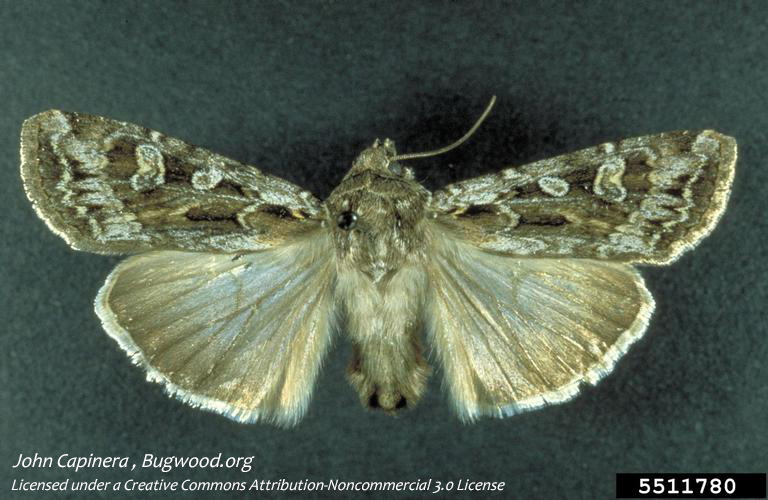
Adult miller moths emerge in late spring.
After ACW pupate, the adult miller moths fly to high elevations, leaving no fingerprints behind. The moths spend the summer feeding on nectar and being fed upon by bears

The following fall, the moths catch wind currents back to low elevations. The capriciousness of wind makes it unlikely that eggs will be laid in the same place more than once. A remote sensing study found that over 80% of die-off sites do not experience die-offs the following year (Weisberg et al. 2017). 

However, both recent federal reports overlook the evidence and state that fungal pathogens cause cheatgrass die-offs. Both cite Meyer et al. 2016’s book chapter, “Community ecology of fungal pathogens on Bromus tectorum.” 

Occam’s Razor shaves away fungal pathogens


Occam’s Razor reminds us that the simplest explanation that fits the evidence is usually the correct one. Army cutworms are the simplest explanation for die-offs—with the most evidence. None of the fungi studied by Meyer et al. and described in their 2016 book chapter have been clearly linked to die-offs. They do not report studying pathogenic fungi of exotic mustards, which are also missing from die-off areas and are readily eaten by ACW.
    
Meyer et al. 2016 state that fungal pathogens “sometimes interact to increase the total impact on B. tectorum stand structure, which can result in stand failure or ‘die-off’,” (page 193). They suggest that “thick litter created by [Rutstroemiaceae] may create conditions conducive to the success of Fusarium seed rot organism the subsequent year,” (page 218). This explanation is more complex, less direct, and supported by less evidence than the ACW explanation. 

Differences between ACW and fungi in weather conditions when outbreaks occur, local patterns of damage, and local persistence point all to the former as the most likely cause of die-offs (Table 1).

Weather: Cheatgrass die-offs occur during dry weather. 
Most pathogenic fungi need wet conditions to grow, spread, and infect plants. Army cutworm outbreaks typically occur during dry weather lasting about 1½ years, broken by unusual late summer rain, to reach outbreak levels. Remote sensing work has also found that die-offs occur during drought (Weisburg et al. 2017). 

Local damage pattern: Cheatgrass die-offs are bare soil. 
Three of the five fungi discussed in Meyer et al. 2016, Ustilago bullata, Tilletia bromi, and a type of Rutstroemiaceae, infect cheatgrass without killing the plants. These organisms prevent the production of normal seeds, but do not destroy plants: they do not create the bare patches seen in cheatgrass die-offs.  

Pathogenic fungi can’t move to seek out host plants. Fungi are moved by wind or water, which typically produce spotty local patterns of fungal diseases. Some fungal diseases, such as late blight of potato, which led to the Irish potato famine, can kill essentially all plants in an area. However, these fungi leave fields of decaying plants, not bare areas. Army cutworms consume plants to bare soil. 

Local persistence: Cheatgrass die-offs usually last only one year
The other two fungi discussed in Meyer et al. 2016, Pyrenophora semeniperda and Fusarium spp., kill seeds in the soil; Fusarium spp. can also kill seedlings. P. semeniperda is one of many soil fungi that kill cheatgrass seeds, but the effect of this fungus on cheatgrass stands is negligible (Meyer et al. 2016, page 208). 

Fusarium spp. can be a serious problem in crops, as pathogenic fungi usually persist in an area longer than one year. For example, gardeners rotate tomatoes with other crops and plant resistant varieties to avoid Fusarium wilt (F. oxysporum). Army cutworms, in contrast, leave the scene after creating die-offs, and winds rarely carry moths back to the same spot in later years.


Previous reports of cheatgrass die-offs


Meyer et al. 2016 discuss previous reports of abnormal cheatgrass growth. However, neither appears to have been caused by pathogenic fungi. The first seems to describe an ACW outbreak; the second, a dense stand of cheatgrass. 

Report 1: Cheatgrass winterkill in southwest Idaho in 1960 
Meyer et al. 2016 cite winterkill of cheatgrass observations by Piemeisel 1938; the source is actually Klemmedson and Smith 1964. Klemmedson’s original photos and descriptions of the event are archived at the Rocky Mountain Research Station (below). 

Klemmedson documented the 1960 cheatgrass die-off
Klemmedson describes an event in 1960 near Glenns Ferry, Idaho strikingly similar to the 2003 and 2014 die-offs: large, litter-covered bare areas that end abruptly normal-appearing cheatgrass; unaffected perennial Sandberg bluegrass (Poa secunda); and a summer cover of Russian thistle (Salsola kali). I have suggested that this event, and a similar one in 1949 in Payette County, Idaho, were caused by ACW outbreaks (Salo 2017, slides 26, 27). 

Glenns Ferry, Idaho recorded conditions before the 1960 die-off strikingly similar to those before the 2003 and 2014 ACW outbreaks and cheatgrass die-offs: a previous year of dry weather, heavy September rain, and a dry fall and early winter from October through January (Table 2).


Klemmedson and Smith 1964 suggest that desiccation or pink snow mold caused the 1960 event and cite Sprague’s 1953 description of the mold. According to Sprague, Microdochium nivale = Fusarium nivale) attacks grasses “in late winter, either under the snow or during raw winter weather.” The attacked leaves turn into “pink or straw-colored mats, which dry to paper films,” (page 271). 

However, snow and raw winter weather would have been unlikely during the dry winter of 1959–1960. In addition, Klemmedson’s photos and descriptions show the litter that often covers cheatgrass die-offs, not the papery films of pink snow mold. The weather conditions, photos, and descriptions all point to ACW, rather than pink snow mold, as the cause of the 1960 die-off. 

Report 2: Cyclic succession on abandoned cropland in southern Idaho in 1941 
Meyer et al. 2016 cite Piemeisel’s 1951 report of “degenerate” cheatgrass stands “in which seed production was prevented and stand loss ensued,” (page 195). Meyer et al. 2106 continue, “He credited this effect to increasing intraspecific competition, but it seems plausible that plant pathogens…could have played a role. This process is very similar to the ‘die-off’ or stand failure in B. tectorum monocultures documented in recent years.” 

Piemeisel 1951 describes dense cheatgrass stands
However, the pattern Piemeisel describes (right), and that Meyer et al. say is similar to cheatgrass die-offs, is the opposite of that seen on cheatgrass die-offs. 

Piemeisel reports islands of cheatgrass, “as small as a few feet in diameter…in parts of a field in 1941 where downy chess [=cheatgrass] was beginning to establish,” (page 56). The “degenerate” stand at the center was “a disk composed of a very dense, short growth of immature plants…with barely emerging heads.” Plants in the outer portions of the islands were progressively more robust as the plant density decreased. 

Cheatgrass die-offs, on the other hand, are large bare areas cut out of normal-appearing cheatgrass stands—the inverse of Piemeisel’s islands. He certainly seems to describe intraspecific competition in cheatgrass, not a die-off.

Army cutworms are the most likely cause of cheatgrass die-offs

Researchers and ranchers have watched the larvae consumer cheatgrass, mustards, and the leaves of native shrubs (Salo 2018). The life cycles of cheatgrass and ACW, driven by weather, interact to produce periodic larval outbreaks that create die-offs sporadically across low, dry areas in the intermountain west.

When we understand ACW enough to predict their outbreaks, we’ll know when and where to look for die-offs. My “trapline” in Owyhee County, Idaho monitors fall miller moth flights; nearby weather stations in Grand View and Murphy record precipitation. When conditions that lead to ACW outbreaks occur though the end of January, it’s time to start looking for larvae and die-offs. Reseeding die-offs with desirable native species will let the sown plants get started while there are few cheatgrass seeds in the soil to sprout and compete with them.

Literature cited

Hammon. 2003. Personal communication.
Klemmedson and Smith. 1964. Cheatgrass (Bromus tectorum). Botanical Review 30:226–262.
Remington et al. 2021. Sagebrush Conservation Strategy—Challenges to Sagebrush Conservation. U.S. Geological Survey Open-File Report 2020–1125. 327 p.
Salo and Zielinksi. 2004. Cheatgrass dieoffs: of drought, cutworms, and bears? (poster). Society for Range Management Annual Meeting, Jan. 24–30, Salt Lake City, UT.
Salo. 2017. Army cutworms (Euxoa auxiliaris) consume winter annual plants and shrub foliage. Society for Range Management Annual Meeting, Jan. 29–Feb. 2, 2017, St. George, UT.
Sprague. 1953. Root and crown rots of the grasses. USDA Yearbook of Agriculture 267–272. 

Sunday, October 28, 2012

A Plague with an Upside?

My office phone rang with a missing plants report: miles of cheatgrass had disappeared in Winnemucca, Nevada. It was the spring of 2003

When the rangeland manager on the phone saw the first bare areas, he was surprised. When he found whole valleys without plants, he called the new plant ecologist at the U.S. Geological Survey in Boise. I said I didn’t know where the cheatgrass went, but I’d take a look.

I was looking for a fugitive with few friends. Weedy, nonnative cheatgrass usually blankets large swaths of the Intermountain West. This annual grass moves in after native plants are killed by fire, weakened by drought, or damaged by people or livestock. Cheatgrass sprouts in fall or early spring across the lowest, driest parts of the West. The young plants sink roots to forage for water and nutrients while many of our native plants are dormant. Before cheatgrass plants die in spring, each produces a bumper crop of seeds to continue the cycle the next year.

A few days after the alarming phone call, I stood in what had been rangeland. The area seemed to have been bladed for a  parking lot. The few surviving plants were a short hike apart. The survivors were all native perennials--and they were thriving. The globemallow, indian ricegrass, and squirreltail were guzzling the water and nutrients left after the usual crop of cheatgrass failed to grow.

At the edges of the cheatgrass die-off, the ‘dozer driver seemed to have stopped for lunch and forgotten to come back. Miles of bare soil ended abruptly in normal-looking cheatgrass. The farthest edge of the dieoff ended partway up the toe slope of the nearby mountains, as if the ‘dozer driver had avoided driving on the steepest slopes.


I had a long list of ways plants can die; I needed help narrowing down my list. I stopped at the nearest ranch and asked about the missing cheatgrass.

The couple working in the corrals was younger than the century-old ranch, but they hadn’t seen a year without cheatgrass before. “My son says it’s army cutworm. He lives up the road,” said the woman, who wore a painful-looking shiner inflicted by one of the horses.

The son, Jim, described seeing insect larvae “eating every green shoot” on a warm, dry January evening. “It was warmer than today,” he said, as I shivered in the June dusk in his front uaof his house. Jim did what researchers do: he photographed the insects and took some to the local U.S. Department of Agriculture office. The entomologist ID’d them as army cutworms.

As I drove away, I congratulated myself on inquiring locally to solve the mystery in record time. Then I did what researchers do: I got a second opinion.

“Army cutworms??” My entomologist friend’s voice shot up in surprise. “No way. Army cutworms would never eat that much cheatgrass.” She vouched for the insects--they were innocent. I needed a third opinion.

The next entomologist laughed out loud. I went back to my list of Ways Plants Can Die.

Walking to and from work, or driving to remote field sites, I went over my mental list: Frost? Yes, cold air drainage might damage plants in the bottoms of the valleys and leave those on nearby slopes. Fungal root disease? Probably not during a warm, dry winter, as fungi need abundant moisture. And how could a fungus kill ALL the plants in an area? And why would it suddenly stop killing plants at the edges of patches?

Months later, a second witness came forward and fingered army cutworms. A researcher in northern Utah had seen larvae destroying his cheatgrass experiment.

Finally, that fall, I found an entomologist in western Colorado who had seen army cutworms devouring cheatgrass and crops in his area. The outbreak of larvae hadn’t surprised this witness, as he’d noticed more miller moths than usual the previous fall. He knew they would lay eggs that would hatch into army cutworms.

Although few people know army cutworms in the Intermountain West, residents east of the Rockies know both larvae and adults all too well.

Between its summer wildfires and winter blizzards, Colorado’s Front Range suffers semiannual plagues of miller moths. Billions of the insects invade in spring and late summer as they migrate from the Great Plains to and from high peaks of the Rocky Mountains.

The moths annoy local residents by loitering around lights, invading homes, and defecating on walls. Media describe “squadrons” of moths “attacking” and “dive-bombing” people. The insects’ unpleasant habits make it hard to appreciate the impressive journey these tiny creatures complete: on a two-inch wing span, miller moths make a thousand-mile round trip on their summer vacation.

The moths that fly through Denver and Fort Collins each spring hatched in the soil of the Great Plains the previous winter. The army cutworm larvae hide underground during the day and come out to feed at night. Sprouting fields of wheat, and other crops, are just the right height for the hungry insects.

The cutworms' nocturnal habit makes it hard to catch them in the act of destroying crops. The young larvae are so tiny that it's hard to see them at all--until it's too late. The insects earn their moniker when they reach 1½ inches and are mostly jaws. After consuming all the food in an area, the army marches off in search of more. The destruction ends when the troops stop, drop, and pupate in the soil. They emerge several weeks later as miller moths.

Although a long, wet spring can persuade the moths to linger and feed along the Front Range for weeks, their summer home is high elevation slopes around Yellowstone Park. The insects feed at night and congregate among the rocks of cool talus slopes during the day. The gatherings of moths are grizzly bear banquets. By eating as many as 40,000 moths a day, the bears get up to half their yearly energy from the maligned miller moths.

In late summer, the surviving moths turn their back on the Rockies and head back east to the Great Plains. Or do they all? Do any of the Yellowstone moths fly west? Or do "our" miller moths spend their summers in talus slopes closer to home?

Farmers in the Great Plains check their fields for army cutworms, homeowners along the Front Range recalk their windows before the miller moth migration, and Yellowstone’s bears count on the plump insects to get them through the next winter. But the army cutworm outbreak of 2003 was a surprise attack in the Intermountain West. We don’t know exactly why there were so many larvae that year or even where the adults spent the previous summer.

I blame army cutworms, perhaps working with a pathogen accomplice, for the disappearance of hundreds of thousands of acres of cheatgrass in the Intermountain West in 2003. The weather was perfect for the insects, the cheatgrass disappeared when the larvae were feeding most voraciously, and their need to stop eating and pupate could account for the sharp borders of the bare areas. (Full disclosure: some other researchers scoff at the idea.)

We haven't had a big army cutworm year since 2003--or seen big cheatgrass dieoffs. But the insects are still here, waiting for their next opportunity. Our warming climate could give them many opportunities in the future.

Army cutworms need both a mild winter and lots of eggs to reach impressive numbers. That means lots of miller moths have to return from their summer journey. When we see high numbers of miller moths in late summer, followed by a warm, dry winter, we need to start looking for army cutworms on our rangelands. When we see bare areas where we expect to see cheatgrass, it’s time to get out the seeders and reseed those areas with native perennial plants. Without competition from cheatgrass, the seeded plants will be able to establish vigorous stands that can hold the line against cheatgrass.

In August and September, I trapped and counted miller moths in the foothills of the Boise Front. Pheromones--scents that female moths make to attract males--lured males into the traps.


When I catch lots of moths in fall and we have heavy late summer rain followed by a dry winter, I'll start looking for army cutworms and watching for bare areas. The next time someone calls with a missing cheatgrass report, I'll start with my prime suspect.