Showing posts with label Science. Show all posts

Friday, April 5, 2019

Hunting the ancient agave

Agaves spend much of their lives as toothy, spikey plants we avoid while hiking. Most agaves bloom only once, throwing their heart and carbohydrates into raising an exorbitant stalk of fragrant flowers that ripen into dry fruits stacked with flat, black seeds. We're captivated by the transformation from spikey to florescent.

Wendy Hodgson makes agave seeds fly in Cascabel.
However, for over 8,000 years, people have harvested agaves just before flowering, usurping the carbohydrates in the stem for human food and beverage. The leaves also provide fibers for rope, baskets, bags and sandals.

Although people have used agaves continuously in Mexico, the plants' cultivation and culture faded from what is now Arizona by the 18th century. Residents of the Middle San Pedro Valley have periodically wondered if we could grow agave in our area. After all, Sobaipuri Native American agave fields dot our community, and wild agaves grow in the valley.

When this question came up again last winter, we learned that survivors of pre-Columbian cultivated agave had recently been found in our area. Wendy Hodgson and her colleague Andrew Salywon, both with the Desert Botanical Garden, named the new species Agave sanpedroensis. Wendy and Andrew even suggested that this low-water-use crop could be revived to diversify agriculture and stimulate new industries in the U.S. Southwest.

Agave sanpedroensis.
We contacted Wendy, who was as eager as we were to connect. In January 2019, she told a packed Cascabel Community Center about the eight (and counting) species of formerly cultivated agaves she and her colleagues have found. In February, dozens of people braved blustery weather on a follow-up field trip. Wendy explained how she recognizes the different species of agaves and outlined how we can help her survey the plants in our valley.

Wendy and Andrew work with archaeologists, who have documented extensive agave fields at many sites in central and southern Arizona. Rows of rocks along contour lines slowed runoff across the fields and rock mulch piles reduced evaporation. Near the fields, archaeologists find knives used for removing leaves and roasting pits where agave stems, or "heads," were baked to sweetness.

The plants we see today are genetically identical to those the Sobaipuri and other groups developed to suit their needs. Unlike their wild relatives, these cultivated agaves produce little or no seed. Instead, the plants reproduce vegetatively, usually by pupping, to produce offspring identical to the parent. Cultivated agaves are also sweeter than their wild relatives and their leaves are easier to cut.

After surviving drought, insects, and rodents for centuries--or millennia--climate change and development threaten these rare plants. As cultivated crops, they fall into a protection gap: the Endangered Species Act protects only wild species and the Archaeological Resources Protection Act protects only inanimate artifacts.

Wendy fears that these recently discovered, living storehouses of information on people, culture, and plants could be lost. She is helping residents of the Middle San Pedro Valley learn about the ancient agaves in their area and work to protect them.

Thursday, September 20, 2018

An entomological who dunnit

Jeff Lockwood's book, Locust: The Devastating Rise and Mysterious Disappearance of the Insect That Shaped the American Frontier is available on Amazon, where I reviewed it.

Scientific understanding usually shuffles along in the two-to-three-year steps of graduate student research projects. Big, intriguing mysteries take longer to resolve, but are more fun to research—and more interesting to read about.

Jeff Lockwood tackled the mystery of why the Rocky Mountain locust went extinct at the dawn of the 20th century. The species' periodic irruptions rivaled the bison in terms of biomass and the 1875 outbreak still horrifies young readers of Laura Ingles Wilder's, On the Banks of Plum Creek. Then the insects disappeared.

In his book, Lockwood recounts the challenges of sleuthing out a big mystery. Big research projects require new research techniques and years of soul-crushing work counting, dissecting, measuring, and recording data. Papers describing new research findings are sometimes rejected by academic journals; colleagues sometimes snicker. Unearthing the Rocky Mountain locust's secrets required field work at remote high elevation "grasshopper glaciers" reached by difficult climbs in foul weather.

Big research projects need lots of brains and lots of backs. Lockwood doesn't hog the limelight; he credits his employees, students, and colleagues for their inventions and insights. Field research is carried out by people, so it's a social activity, which Lockwood captures. A twenty-five-mile hike, completed in the dark, isn't quite as bad when you're not suffering alone, and joy shared at discovery is joy multiplied.

Other ecological changes in the late 19th century might have been linked with the locust's disappearance: decline of the bison, changes in climate, or reduced burning by Native Americans. Lockwood guides readers through the possibilities and explains why he rejects each. He focuses instead on the ecological bottleneck of limited egg-laying sites in valleys of the northern Rocky Mountains. Lockwood determines that when settlers plowed and grazed these areas, they destroyed the locust's eggs, and with them, the species. The culprit was settlers, in valleys, with plows, by accident.

Although the Rocky Mountain locust's sky-filling swarms are gone with the thundering bison herds, Lockwood ends his book by wondering if a few individuals may live incognito in less disturbed valleys of the Rockies. Another big, intriguing mystery.

Thursday, May 12, 2016

The vineyard is a-LIVE

Vineyards are evocative, pastoral landscapes that invite visitors to linger and relax with a glass of wine. These agricultural fields can be more or less environmentally friendly, depending on how they are managed. Bitner Vineyards is the first and, so far, only Low Input Viticulture and Enology (LIVE) certified vineyard in Idaho.

Ron and Mary Bitner use science-based practices to protect water, soil, and pollinators. The couple provide habitat for pollinators and use cover crops, integrated pest management (IPM) techniques, and biological control methods to reduce their use of pesticides. Embracing science comes naturally for Ron Bitner--his first career took him around the world as an expert on leafcutter bees for pollinating alfalfa.

I wrote about the Bitner’s LIVE vineyard in the Spring issue of Edible Idaho.

Tuesday, August 4, 2015

Who should monitor federal rangelands?

“The fox guarding the henhouse.” That's what Linda Price expects some to say about a new rangeland monitoring program. I quoted the manager of the federal Bureau of Land Management (BLM) Field Office in Salmon, Idaho, in a recent article.

The Idaho State Department of Agriculture (ISDA) saw the need for more information on the condition of BLM rangelands in the state and came up with a solution. Brooke Jacobson, ISDA’s coordinator for the project, helps ranchers get start collecting vegetation data on land they lease for livestock grazing. Meanwhile, the BLM’s vegetation specialists are stuck at their desks doing paperwork. A steady stream of time-sucking lawsuits provides job security, but keeps agency employees away from their monitoring duties.
Brooke shows ranchers how to take annual photos at BLM monitoring sites and send their data to the agency. Ranchers can also attend one of the University of Idaho’s monitoring workshops. In this pilot program, ranchers will monitor only upland rangelands, not sensitive riparian areas. They won’t be measuring, or even counting, vegetation; they’ll be collecting photographic data.

Even with training and help from Brooke, some people might not think ranchers are up to the task. The skeptics must never have worked on a veg crew.

When I hired crews to collect vegetation data at the U.S. Geological Survey, I didn’t ask if applicants knew how to count plants. I asked the hard question: “Can you handle a summer living out on the Sagebrush Sea?” Anyone who can tolerate boring, repetitive tasks can learn to collect data; only a few hardy souls can sleep in a tent, haul water, and build a toilet with a shovel all summer. Data collection ain’t rocket surgery.
Nonscientists collecting data is nothing new. Amateur and professional scientists work together on the North American Breeding Bird Survey. They receive the same training and their data go into the same valuable dataset on bird numbers and distribution. Citizen scientists also record the seasonal changes in plants and animals for the National Phenology Network. This information helps scientists identify patterns of global climate change, which helps planners address the social and economic stresses that result.

You could argue that ranchers might fudge the data when monitoring their grazing lands. If you did, I’d point out that anyone could be tempted to blink at the wrong time while reading data. Every BLM employee has an opinion on livestock. Researchers have their favorite hypotheses. Even universities listen to their supporters, legislators, and alumni, all of whom have biases.

Software developers are making data collection easier and more accurate for both citizen and career scientists. Before Amazon ever heard of drones, Terry Booth, at the USDA’s Agricultural Research Service in Cheyenne, WY, was photographing rangelands from light aircraft. The photos were clear enough to count plants and measure bare ground. In other words, they were detailed enough to monitor rangelands.

It’s been years since I saw a rancher with a flip phone (four months since I gave up mine). Smart phone cameras take excellent pictures and a University of Nebraska app makes photographing the same spot every year...a snap.

Ranchers and BLM employees look through the same viewfinder, but they see different things. Most agency workers move several times during their career. Most ranchers stay put for decades; their families often stay rooted for generations. Ranchers experience many El Niño and La Niña years on the same land. They see swings in precipitation and note the effects on plants and livestock. Ranchers are on the land 24/7/365 and they see things.
When my friends Jake Weltzin and Steve Archer investigated why mesquite trees were invading Texas grasslands, they asked the local ranchers. Guy and G. D. London told my friends that mesquite moved in after they killed the prairie dogs. Jake and Steve tested the ranchers' hypothesis and found that prairie dogs keep mesquite out of grasslands by clearing away seedpods and stripping bark from seedlings.
Rumor has it that ranchers remember three years: this year, last year, the best year. Researchers know memories fade and insist on written data. In the words of Adam Savage, one of Discovery channel’s MythBusters,“The only difference between screwing around and science, is writing it down.”

Ranchers will go one better when they monitor their rangeland: they’ll take pictures. Then they're write down when and where they took them.

Thursday, July 2, 2015

Three degrees, no garlic scapes

In three agriculture degrees, several botany classes, and decades as a plant ecologist, I never ran into garlic scapes. I know and use terms such as “homoploid hybrid species” and “Pseudotsuga menziesii.” But, until last Saturday, I’d never met a garlic scape.

Jessica and Jeremy of Swift River Farm introduced me to the curvy, green flower shoots at their booth at the Lemhi County Farmers Market in Salmon, Idaho. The couple, who also sell subscription shares in their farm’s produce, spun an improbable tale of sex and scapes.

Long before humans began sautéing cloves or warding off vampires with the heads, garlic dispensed with seed. The plants gave up sex. Each of these Shakers of the plant world eschewed others of its kind and simply produced garlic heads that grew into plants that produced garlic heads.

Jeremy and Jessica embrace garlic’s celibacy and plant individual cloves, which grow into plants that produce full heads. Each plant is genetically identical to its single parent, which is identical to its single parent, and so on back through time.

Oddly, some kinds of garlic still produce flowers, as if trying to blend in with the rest of the plant world. While other plants produce flowers with male and female parts that swap genes with the opposite flower parts to form seeds, garlic flowers form bulbils. Bulbils look like tiny cloves and grow into plants identical to their parent.

The scapes I discovered at the market are garlic flower stalks with developing bulbils. I cut open one of the largest developing flower clusters.


I’ve also learned there are two kinds of garlic: soft neck and hard neck. The garlic in grocery stores is the former, as it stores well enough to keep the produce bins stocked all year. I might be excused my garlic-scape ignorance, as they are only produced by hard neck garlic. These types are grown in cooler climates and usually consumed locally, as they don’t store well.

My new friends, the garlic scapes, gave me the perfect excuse to skip my usual toast-and-yogurt breakfast and linger over an omelet-and-garlic-scape-potato Sunday brunch.

Sunday, June 22, 2014

Extreme Mustang Makeover, the Bud Edition

As a child, I was enchanted by the story of "Wild Horse Annie" fighting to save America's free-roaming horses. I was desperate to leave boring junior high in snoozeville Minneapolis and head west. I dreamed of spending all day outside on a horse and sleeping under the stars every night.

As an adult, I live in the West and sleep outdoors more than most people would want to. But the "wild" (they're actually feral) horse question is more complicated than it seemed in junior high.


The Bureau of Land Management (BLM) reports that almost 50,000 [Update: 80,000 in 2020] feral horses and burros still roam the western range. The agency, which manages the federal lands where the animals live, also houses a similar number in pens and pastures.

The BLM periodically rounds up and removes some of the horses so they don't interfere with other uses of public land. The agency tries to find homes for them, but their corrals are starting to look like the Humane Society during kitten season. In 2013, only 2,311 horses and burros were adopted, less than half the number adopted in 2005. [Update: 5,130 horses and burros were adopted in 2019.]A steady parade of horses leave the range and end up in the permanent limbo of BLM holding facilities.

A recent National Academy of Sciences (NAS) report points out that the BLM doesn't actually know how many feral horses roam the West. The NAS detected a lot of guesstimating in the agency's counting process, but was able to conclude that the horse population is growing 15-20% per year.


The report's most discouraging finding is the reason for the rapid growth rate: the BLM's removal program. When there are fewer horses on the range, there's more food for those left; the remaining horses get busy and make more horses. Although birth control would be a humane solution, the NAS doubted that it alone could reduce population growth to a sustainable rate.

The Mustang Heritage Foundation tells the story of the free-roaming horses that fired my imagination as a child. Their Extreme Mustang Makeover springs a handful of lucky horses from BLM limbo and pairs them with experienced trainers. Each pair has 100 days to get ready for the show ring, after which the horses find new homes at auction. The transformation from wary mustang to confident companion was recorded in the documentary Wild Horse Wild Ride. Spoiler alert: get your hankies out; the auction breaks up some close cross-species friendships.

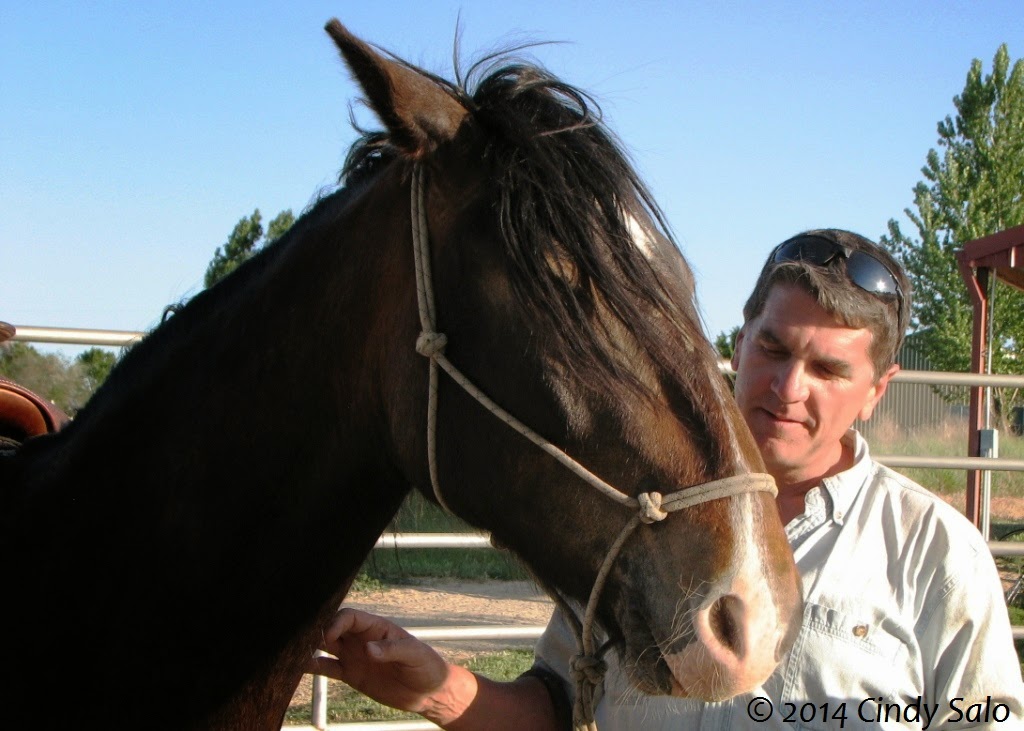
My friend Matt Livengood was selected to participate this year. He's teaching This Bud’s for You (Bud, for short) everything he needs to know to be a safe, relaxed, equine partner for a successful bidder. A group of friends got together at Matt and Alayne's Sweet Pepper Ranch on Memorial Day. After a barbeque, beverages, and bantering, we gathered at Bud's corral to watch his progress.

Matt had Bud's saddle and bridle on before I got my camera out. Bud was already a pro at this part.

Matt had been putting weight on the saddle for many days...

...and even lying across the saddle while he patted Bud, swung the stirrup back and forth, and got Bud used to the strange things people do when they ride horses.

There were lots of human and canine spectators offering Bud advice during his lesson.

Whoa! Once in a while Bud had to stop and collect himself.

Matt kept working with Bud until...he swung up and sat on him. Bud couldn't believe his eyes; there was a person on his back for the first time!

Good job, Bud--and Matt!

Matt and Bud listened to each other constantly during the evening.

Bud looked pleased with himself (and relieved) after his first ride.

Bud even followed Matt without a lead rope. It showed he was paying attention and trying to understand what Matt wanted him to do.

Come watch Bud and Matt in Idaho's first Extreme Mustang Makeover at the Nampa Horse Park, July 25-26. If you languished in junior high, dreaming of roaming the West on horseback, this Bud could be for YOU.

Sunday, December 15, 2013

Reestablishing Fire Cycles in the Great Plains

Before Europeans arrived, fires routinely swept the Great Plains, rejuvenating grasses and suppressing trees spreading from the riparian areas that cross the region. Whether lightening caused or set by Native Americans, fire maintained the grasslands and provided lush grazing for bison. Europeans plowed the grasslands for crops and put out wildfires, disrupting natural fire regimes.

Today, land managers in the Great Plains are setting planned burns to reintroduce fire and reestablish fire cycles. I wrote a fact sheet about using planned burns for the Great Plains Fire Science Exchange (GPFSE).

The GPFSE increases understanding and improves management of fire in the Great Plains. This region stretches from Montana and North Dakota to central Texas. The Exchange is funded by the Joint Fire Science Program (JFSP). The JFSP funds research on wildland fires needed by policy makers and land managers.