Showing posts with label Bureau of Land Management. Show all posts

Tuesday, August 4, 2015

Who should monitor federal rangelands?

“The fox guarding the henhouse.” That's what Linda Price expects some to say about a new rangeland monitoring program. I quoted the manager of the federal Bureau of Land Management (BLM) Field Office in Salmon, Idaho, in a recent article.

The Idaho State Department of Agriculture (ISDA) saw the need for more information on the condition of BLM rangelands in the state and came up with a solution. Brooke Jacobson, ISDA’s coordinator for the project, helps ranchers get start collecting vegetation data on land they lease for livestock grazing. Meanwhile, the BLM’s vegetation specialists are stuck at their desks doing paperwork. A steady stream of time-sucking lawsuits provides job security, but keeps agency employees away from their monitoring duties.
Brooke shows ranchers how to take annual photos at BLM monitoring sites and send their data to the agency. Ranchers can also attend one of the University of Idaho’s monitoring workshops. In this pilot program, ranchers will monitor only upland rangelands, not sensitive riparian areas. They won’t be measuring, or even counting, vegetation; they’ll be collecting photographic data.

Even with training and help from Brooke, some people might not think ranchers are up to the task. The skeptics must never have worked on a veg crew.

When I hired crews to collect vegetation data at the U.S. Geological Survey, I didn’t ask if applicants knew how to count plants. I asked the hard question: “Can you handle a summer living out on the Sagebrush Sea?” Anyone who can tolerate boring, repetitive tasks can learn to collect data; only a few hardy souls can sleep in a tent, haul water, and build a toilet with a shovel all summer. Data collection ain’t rocket surgery.
Nonscientists collecting data is nothing new. Amateur and professional scientists work together on the North American Breeding Bird Survey. They receive the same training and their data go into the same valuable dataset on bird numbers and distribution. Citizen scientists also record the seasonal changes in plants and animals for the National Phenology Network. This information helps scientists identify patterns of global climate change, which helps planners address the social and economic stresses that result.

You could argue that ranchers might fudge the data when monitoring their grazing lands. If you did, I’d point out that anyone could be tempted to blink at the wrong time while reading data. Every BLM employee has an opinion on livestock. Researchers have their favorite hypotheses. Even universities listen to their supporters, legislators, and alumni, all of whom have biases.

Software developers are making data collection easier and more accurate for both citizen and career scientists. Before Amazon ever heard of drones, Terry Booth, at the USDA’s Agricultural Research Service in Cheyenne, WY, was photographing rangelands from light aircraft. The photos were clear enough to count plants and measure bare ground. In other words, they were detailed enough to monitor rangelands.

It’s been years since I saw a rancher with a flip phone (four months since I gave up mine). Smart phone cameras take excellent pictures and a University of Nebraska app makes photographing the same spot every year...a snap.

Ranchers and BLM employees look through the same viewfinder, but they see different things. Most agency workers move several times during their career. Most ranchers stay put for decades; their families often stay rooted for generations. Ranchers experience many El Niño and La Niña years on the same land. They see swings in precipitation and note the effects on plants and livestock. Ranchers are on the land 24/7/365 and they see things.
When my friends Jake Weltzin and Steve Archer investigated why mesquite trees were invading Texas grasslands, they asked the local ranchers. Guy and G. D. London told my friends that mesquite moved in after they killed the prairie dogs. Jake and Steve tested the ranchers' hypothesis and found that prairie dogs keep mesquite out of grasslands by clearing away seedpods and stripping bark from seedlings.
Rumor has it that ranchers remember three years: this year, last year, the best year. Researchers know memories fade and insist on written data. In the words of Adam Savage, one of Discovery channel’s MythBusters,“The only difference between screwing around and science, is writing it down.”

Ranchers will go one better when they monitor their rangeland: they’ll take pictures. Then they're write down when and where they took them.

Monday, October 27, 2014

One Mustang Adopted, 50,000 to Go

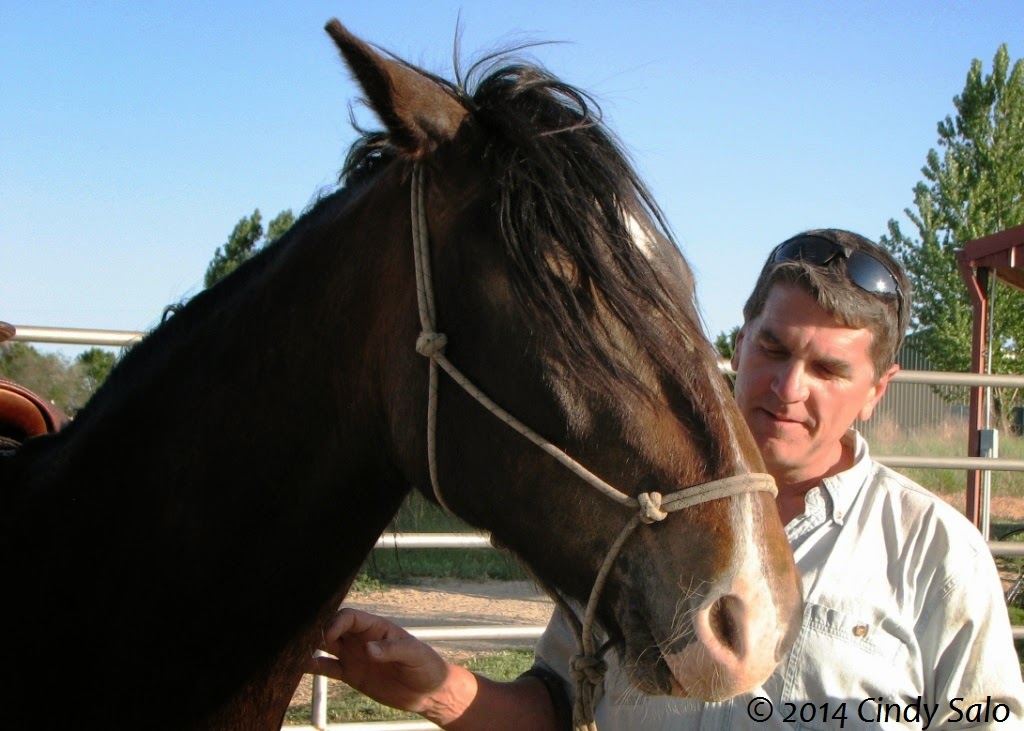
My friend Matt Livengood had a little over three months to teach Bud the Mustang everything he needed to know to become an adoptable horse. Bud arrived in April, 100 days before the Extreme Mustang Makeover event in Nampa, ID. By the end of July Bud was a different horse.

Bud wore his Bureau of Land Management (BLM) neck tag for weeks; he wouldn't let Matt get close enough to put a halter on him. The tag had been Bud's ID since he was rounded up on the Black Rock Desert of Nevada and taken to a BLM holding facility. Bud left behind almost 50,000 [Update: 80,000 in 2020] other horses and burros waiting for adoption in BLM corrals.


When I visited Bud the first time he stayed as far away from me as he could in his round pen. He watched me closely and smelled for danger. Bud got his name from his size and resemblance to the Budweiser Clydesdales: he looked like he could pull a beer wagon when he trotted, furry fetlocks flying. Matt hoped his full name, This Bud's for You, would encourage bidders at the Mustang Makeover auction.


The early Bud was a rough-looking, wary guy. He was anxious and didn't look like a happy horse.

Several of Bud's fans were on hand the first time Matt sat on his back at the end of May. Bud was wearing his summer coat by then, which let his dabbles show. By this time, Bud would let his fans feed him grass and pat him.

Matt might have been more patient with Bud than Bud's own mother was. Because Matt never got flustered, Bud had no reason to misbehave.

Bud's a thinker. Once he had time to mull over his new life, he was in with all four feet. He watched, tried, learned, and seemed to enjoy the new activities and experiences. When the Makeover rolled around, the formerly free-roaming mustang was living in a stall, riding in a trailer, and behaving like a saddle horse. Bud was ready to leave Matt for a permanent home.

When I walked up to Bud at the Makeover he greeted me and wanted to know all about me: what I smelled like, what I sounded like, what my shirt tasted like, and whether or not I was going to use those handy human appendages to scratch him. (I did.)

Somewhere along the way, Bud had learned about paper. He decided it was good to eat. One bite and much of the diagram of the trail course he was to follow at the Makeover disappeared. Alayne Blickle, Matt's wife, said Bud just wanted to digest the course. Matt studied what was left and took Bud through his paces as if they were at home in their own arena. Except, at home there wasn't a crowd of people making a big scary noise with their handy appendages. You can watch Matt and Bud here.

"Team Bud," the friends who had come to cheer him on and see him off to his new home, was thrilled when our pair finished the prelims in the top ten and moved on to the finals. We sprang into action and developed a beach-themed routine for the evening performance. Team members ran to the dollar store for supplies, created a cardboard Dalmatian to ride in a borrowed red Radio Flyer wagon, and downloaded and dubbed music. We were sure Bud would have as much fun with the routine as we did.

Matt kept the diagram for the finals away from Bud as they practiced.

Bud turned to show off his dapples as he warmed up.


I made my horse show debut in a Hawaiian shirt when I helped set up beach chairs and a horse-sized beach ball in the arena. Despite Bobby McFerrin singing Don't Worry, Be Happy on his soundtrack, Bud was worried. He saw an even larger crowd of people and an odd collection of objects; his ears hurt from the rock concert-level PA system. Bud wasn't happy.

Team Bud watched its namesake melt down in the arena and knew we'd gotten carried away and pushed Bud too fast.

Matt stayed calm and waited to see if Bud would relax on the beach. He didn't. By the time the Budweiser ad at the end of his soundtrack suggested that "you've said it all," Bud had had all he could stand. Once he got away from the noise and strange sights, Bud calmed down and recovered.

Team Bud huddled in the stands and worried about what kind of home Bud would go to after we'd upset him with our beach idea. My stomach hurt and my mouth was dry while I watched the other finalists' routines.

It was hard to listen to the bidding for our dappled brown, melted down Bud. A woman in back was bidding. She seemed nice; would she get him? Yes. No. Yes; she did!

I wasn't the only member of Team Bud who quizzed his new owner after the auction. When she told me her plans for Bud, I knew she had looked through his temporary loss of composure and seen the sweet, curious, willing horse he is: Bud will be her next extreme trail riding horse.

These events test horses' and riders' ability to go over, under, and through obstacles made of wood, water, and soil. The horses have to back through some obstacles and others move when the horses step on them.

Bud has been elevated to royalty in his forever home: he's now Prince of Bud, or Prince for short. His new human companion is thrilled with his "willingness to learn, calm demeanor, and how fast he picks up on new things." In short, "He truly is my dream horse." No word on how many times her kids have used the excuse, "The horse ate my homework."

Sunday, June 22, 2014

Extreme Mustang Makeover, the Bud Edition

As a child, I was enchanted by the story of "Wild Horse Annie" fighting to save America's free-roaming horses. I was desperate to leave boring junior high in snoozeville Minneapolis and head west. I dreamed of spending all day outside on a horse and sleeping under the stars every night.

As an adult, I live in the West and sleep outdoors more than most people would want to. But the "wild" (they're actually feral) horse question is more complicated than it seemed in junior high.


The Bureau of Land Management (BLM) reports that almost 50,000 [Update: 80,000 in 2020] feral horses and burros still roam the western range. The agency, which manages the federal lands where the animals live, also houses a similar number in pens and pastures.

The BLM periodically rounds up and removes some of the horses so they don't interfere with other uses of public land. The agency tries to find homes for them, but their corrals are starting to look like the Humane Society during kitten season. In 2013, only 2,311 horses and burros were adopted, less than half the number adopted in 2005. [Update: 5,130 horses and burros were adopted in 2019.]A steady parade of horses leave the range and end up in the permanent limbo of BLM holding facilities.

A recent National Academy of Sciences (NAS) report points out that the BLM doesn't actually know how many feral horses roam the West. The NAS detected a lot of guesstimating in the agency's counting process, but was able to conclude that the horse population is growing 15-20% per year.


The report's most discouraging finding is the reason for the rapid growth rate: the BLM's removal program. When there are fewer horses on the range, there's more food for those left; the remaining horses get busy and make more horses. Although birth control would be a humane solution, the NAS doubted that it alone could reduce population growth to a sustainable rate.

The Mustang Heritage Foundation tells the story of the free-roaming horses that fired my imagination as a child. Their Extreme Mustang Makeover springs a handful of lucky horses from BLM limbo and pairs them with experienced trainers. Each pair has 100 days to get ready for the show ring, after which the horses find new homes at auction. The transformation from wary mustang to confident companion was recorded in the documentary Wild Horse Wild Ride. Spoiler alert: get your hankies out; the auction breaks up some close cross-species friendships.

My friend Matt Livengood was selected to participate this year. He's teaching This Bud’s for You (Bud, for short) everything he needs to know to be a safe, relaxed, equine partner for a successful bidder. A group of friends got together at Matt and Alayne's Sweet Pepper Ranch on Memorial Day. After a barbeque, beverages, and bantering, we gathered at Bud's corral to watch his progress.

Matt had Bud's saddle and bridle on before I got my camera out. Bud was already a pro at this part.

Matt had been putting weight on the saddle for many days...

...and even lying across the saddle while he patted Bud, swung the stirrup back and forth, and got Bud used to the strange things people do when they ride horses.

There were lots of human and canine spectators offering Bud advice during his lesson.

Whoa! Once in a while Bud had to stop and collect himself.

Matt kept working with Bud until...he swung up and sat on him. Bud couldn't believe his eyes; there was a person on his back for the first time!

Good job, Bud--and Matt!

Matt and Bud listened to each other constantly during the evening.

Bud looked pleased with himself (and relieved) after his first ride.

Bud even followed Matt without a lead rope. It showed he was paying attention and trying to understand what Matt wanted him to do.

Come watch Bud and Matt in Idaho's first Extreme Mustang Makeover at the Nampa Horse Park, July 25-26. If you languished in junior high, dreaming of roaming the West on horseback, this Bud could be for YOU.