Showing posts with label Weather. Show all posts

Monday, March 24, 2014

Late Winter Rains and Army Cutworms

Southwest Idaho's Winter of Ice Fog ended when snow fell in early February. The ridge of high pressure that had smothered us under a season-long inversion broke up. This allowed a procession of rainstorms to wash in from the Pacific.

The Treasure Valley smelled of damp, warm soil. Ranchers, farmers, and water managers cheered the promise of ample irrigation water and plentiful grass. An artist used every shade from Absinthe to Wintergreen to paint the Boise Green Belt in living, photosynthesizing color.

The rains couldn't save this year’s crop of cheatgrass in the dry areas along the Snake River south of Boise. Last fall, a prodigious storm germinated a flush of the winter annual grass, along with its annual mustard cousins. Sadly for the plants, their good luck didn't last. Happily for me, their subsequent misfortune confirmed an accusation I made 11 years earlier.

Clouds of miller moths returned from their summer in the mountains shortly after the rain storm. The moths laid eggs that hatched into army cutworms a month or so later. The larvae soon got down to business eating the tiny green cheatgrass and mustard plants.

The dry winter that followed was ideal for the cutworms, which are thought to develop fungal diseases in damp weather. But the cheatgrass and mustards struggled in the dry weather. The annual plants died from drought or were consumed by army cutworms. Perennial grasses, with their deeper roots, survived on the hills above areas where the annuals had died.


Hungry army cutworms roamed the bare areas looking for food...


...or hid under cowpies, during the day...


...where hungry centipedes stalked.


After the larvae consumed the annual plants, they went arboreal and climbed sagebrush...


...and fourwinged saltbush and kept eating.


Army cutworms also climbed the hills to munch on perennial Sandberg bluegrass, which seemed able to outgrow the larvae's feeding.


When they ran out of plants to eat, the cutworms dined on their fallen comrades.


This spring I caught army cutworms in the act of consuming cheatgrass and creating cheatgrass die-offs. Eleven years had passed since a rancher told me army cutworms were responsible for die-offs I saw near Winnemucca, NV in 2003, and an entomologist later described to me the conditions that allowed the larvae to explode.

Wednesday, February 27, 2013

Good Riddance to the Great Inversion

Although temperatures are still a bit below normal in Boise, we no longer hear the phrase, "historic cold snap" as part of the forecast. When we hit the upper 50s later this week, I’m going to declare an end to the winter of 2012-13 and say good riddance to the Great Inversion.

Our raw, windy Christmas day turned to snow at dusk. The freeway between Nampa, where I spent the day, and Boise, where I live, was closed: there had been a deadly accident on the icy highway. I crept home on a tractionless and deserted side road.

After Christmas, the weather got worse. A large high pressure system moved in over the Pacific Northwest. It brought warm, sunny, dry air that expanded over the existing cold, moist air, trapping it in the valleys. We were socked in tighter than the Republican voting block in the Idaho legislature.

Boise festered at the bottom of the Great Inversion for a month and a half. Day after dismal day, we woke to sinister fog. We dragged ourselves out of bed and fought the urge to go the airport, walk to a ticket counter, and scream, “I don’t care what it costs; get me out of here!” We struggled through a world of suspended ice crystals that pierced our winter jacket-sweater-turtleneck-long underwear layers. We compared notes with coworkers, cashiers, and hairdressers, “I haven’t seen a winter like this in the [fill in the blank with the number of years you’ve lived in Boise] years I’ve been here!” I heard numbers as high as 36. At night, we collapsed in bed, exhausted from the effort of moving through a thousand-foot thick blanket of ice, car exhaust, wood stove smoke, and sugar beet processing plant exhaust.

Just after the New Year, I was hurrying to catch the bus, head down, watching for ice on the sidewalk, so I didn't fall and break a bone, or the laptop in my pack. As I passed a small maple tree, I thought I heard a robin chirp. “Wow; the inversion really got to me,” I thought. “I’m having auditory hallucinations of spring.”

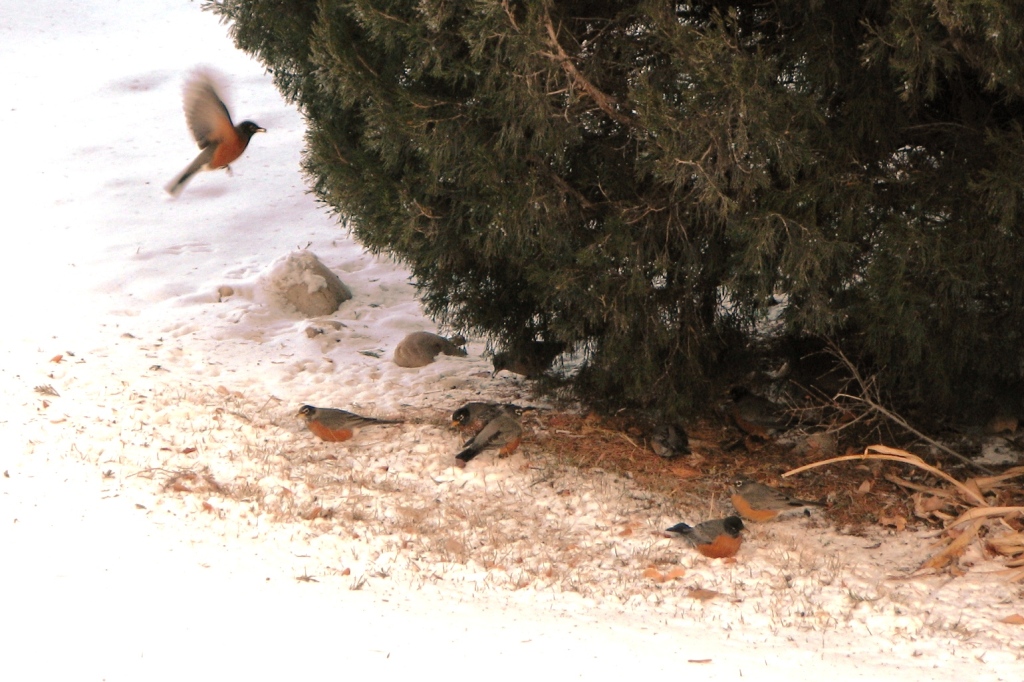
Two weeks later, before the sun was up enough for a clear photo, the back yard of my apartment complex swarmed with dozens of flitting, hopping, flapping male robins. They gobbled juniper berries off the trees by the neighbor’s garage. So many birds were jockeying for perches that each one was only able to grab a few of the dusty, purple cones (as botanists call them) before being displaced by another male. Junipers aren’t made for sitting, so the birds fluttered frantically around the edges of the dense, bristly, branches, trying to impersonate hummingbirds long enough to find a landing spot with food nearby.

The flocks of robins returned several more early mornings over the next week. On their last visit, they were reduced to cleaning up previously rejected cones on the ground under the trees.


I wonder how the flocks of robins fared during the Great Inversion. They re-appear every year in mid January and every year it seems to me they made a poor decision. I noticed them earlier than usual this year and I fear that this year’s visit might have been a fatal mistake for many. This spring, I’ll watch the robins quarrel over nesting territories and listen to them advertise their new digs and search for a mate with more fondness than usual. While the winter of the Great Inversion was trying our sanity, and the strength of our bones when we slipped on the ice, the male robins returned and carried on as usual. They returned and promised us that spring really would come again after all.